- calendar_today August 16, 2025
.
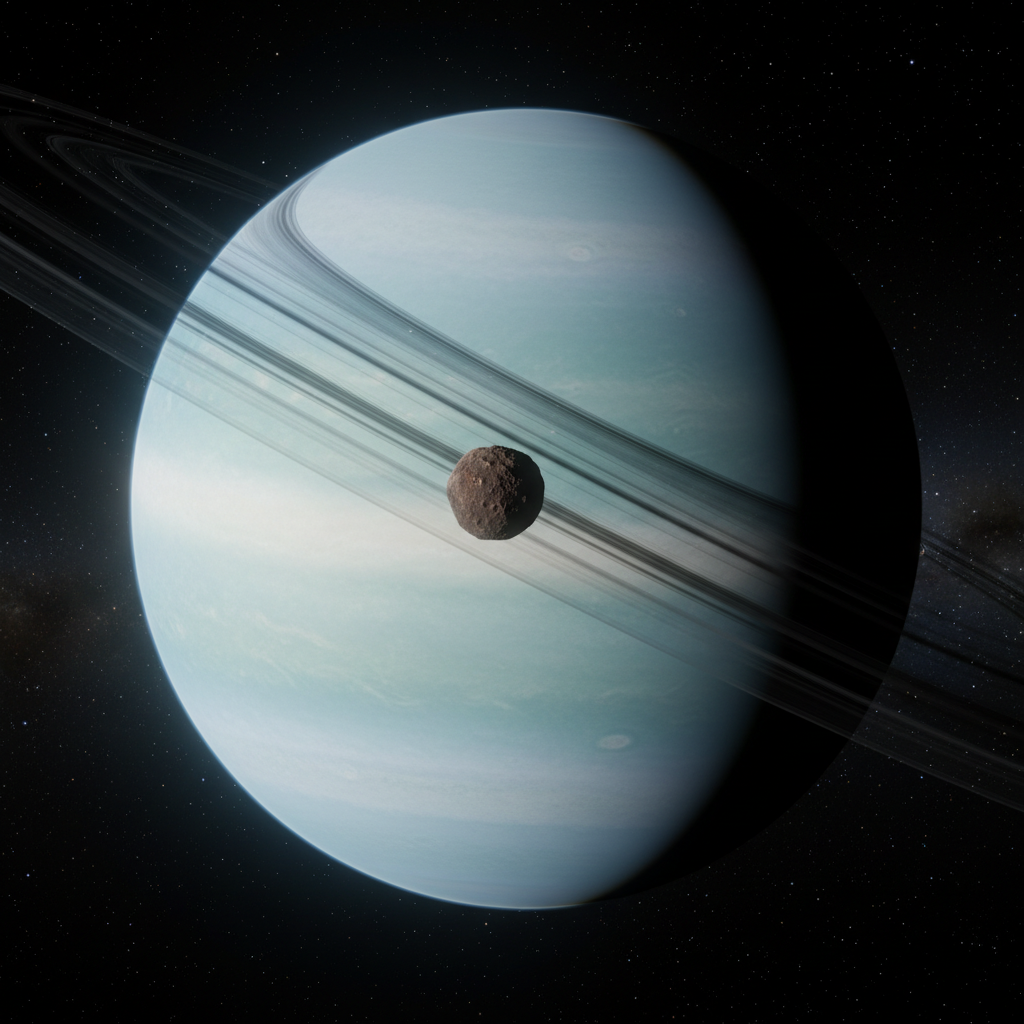
The James Webb Space Telescope has detected a hidden moon circling the ice giant planet Uranus. The new body is part of the Uranus system, which already hosts 28 known moons.
“I have been looking for new moons around Uranus for more than a decade,” said co-discoverer Maryame El Moutamid, a lead scientist in the Solar System Science and Exploration Division of the Southwest Research Institute (SwRI) in Boulder, Colorado. “Finding S/2025 U1 makes the total number of Uranian moons 29, but we still don’t know how many more remain hidden.”
The moon’s discovery came by chance on Feb. 2, as astronomers were observing Uranus with Webb’s Near-Infrared Camera, which obtained a series of long-exposure images, each lasting 40 minutes. In those observations, the tiny moon could be seen as a tiny dot at a distance of just 6 miles (10 kilometers) in diameter. “It’s one of the smallest natural satellites ever seen around Uranus,” El Moutamid said.
Hidden by Uranus’ Faint Glow
The moon was hidden in plain sight. Its size made it too faint for any past mission or telescope to pick it out against the glare of the planet and its bright rings. Even NASA’s Voyager 2 spacecraft, which flew by Uranus in 1986 and is the only spacecraft to visit the planet, missed the moon.
“This is a small moon but a significant discovery,” El Moutamid said. “It shows that Webb is taking our knowledge far beyond what previous missions to Uranus were able to do.”
The newly discovered moon, S/2025 U1, is located about 35,000 miles (56,000 kilometers) from the center of Uranus, in an orbit that is nearly circular and located in the equatorial plane of the planet. It is located between the known moons Ophelia (just outside Uranus’ main ring system) and Bianca. The orbit suggests that the moon was likely formed where it is now located.
To detect the new moon, astronomers had to wrestle with its dimness, its small size, and its fast motion. The bright light of the planet and its rings made it difficult to distinguish the moon. But Webb is designed to detect the faintest infrared light. In a statement, El Moutamid and her colleagues at SwRI’s Uranus Research Group said Webb’s detection “follows discoveries of Uranus’ rings, weather, and atmosphere.”
Unlocking the Secrets of Uranus’ Rings
Scientists have long puzzled over Uranus’ moons and rings. There may be a connection between the tiny new moon and the planet’s ring system. “We suspect that the satellite and at least part of the rings have a common origin, potentially debris from an ancient breakup event,” El Moutamid said.
The discovery also raises questions about the origin of the Uranian ring system. Astronomers have been able to track the motion of the moon long enough to be confident it is not a passing satellite, such as an asteroid. “The discovery raises questions about how many more small moons remain hidden around Uranus, and how they interact with its rings,” El Moutamid said.
Uranus is known to have five major moons—Miranda, Ariel, Umbriel, Titania, and Oberon—along with a group of smaller satellites. The newly discovered object becomes the 14th small moon in that inner system. The planet also has 15 outer moons that orbit far from the planet’s ring system.
No other planet is known to host as many small inner moons so close to each other, which has stumped astronomers. While the satellites are so close to each other that their orbits cross, somehow they do not collide with one another and remain stable. Scientists think the small moons may shepherd Uranus’ narrow rings, keeping them in place.
Astronomer Scott Sheppard, of the Carnegie Institution for Science, who was not involved in the new work but co-discovered another moon orbiting Uranus in 2024, called the discovery “very exciting.” He noted that the object’s proximity to Uranus’ inner ring system makes it especially significant, and he praised Webb’s sensitivity for allowing its detection.
“The size of this moon implies that there are more hidden objects of similar or even smaller sizes in the inner system of Uranus,” said co-principal investigator Matthew Tiscareno of the SETI Institute, “a discovery that also highlights the blurry line between the moons of Uranus and its rings. Their complex inter-relationships hint at a chaotic history that merits further study.”
For one thing, the moon is even smaller than the smallest of Uranus’ known inner moons, each of which is only 8 to 10 miles (12 to 16 kilometers) in diameter and darker than asphalt. The moon is also fainter than the faintest detected Uranian inner moons.
Ancient History
Uranus’ moons have been revealed piece by piece over the centuries. Before Voyager 2’s historic flyby in 1986, only the five largest moons had ever been seen, the earliest discovery dating to 1787. Voyager 2 would add 10 more moons, ranging in size from 16 to 96 miles (26 to 154 kilometers) across. Ground-based telescopes and the Hubble Space Telescope have discovered another 13 small moons, each 8 to 10 miles (12 to 16 kilometers) across and darker than asphalt. While the inner moons are likely made of ice and rock, the outer moons, which orbit beyond Oberon, may be captured asteroids.
For the foreseeable future, Uranus science is set to receive a further boost. A planetary decadal survey from the National Academies of Sciences, Engineering, and Medicine in 2022 has recommended that NASA’s next large planetary mission should be a Uranus Orbiter and Probe. Such a mission would fly in the early 2030s to study Uranus’ tilted rotation, complex magnetic field, atmospheric dynamics, and potential icy ocean worlds among its moons. While there is strong support in Congress for such a mission, funding levels have been a topic of contentious budget debates.
Looking ahead, Sheppard thinks there are likely more moons out there with diameters as small as a few kilometers. “We expect to find them eventually,” he said, either through long-exposure Webb imaging or on future spacecraft missions. El Moutamid and her team are already at work to pin down the orbit of S/2025 U1 and look for more hidden moons.
“Discovering a new moon around Uranus helps scientists understand the formation of its strange system and sheds light on its rings,” El Moutamid said. “It also helps prepare us for future missions to Uranus, such as NASA’s proposed Uranus Orbiter and Probe.”