
- calendar_today August 20, 2025
Carnegie Mellon University researchers presented LegoGPT, which converts plain text instructions into stable Lego constructions through its advanced artificial intelligence model. The system sets a new standard by producing compatible Lego designs from text instructions while guaranteeing their physical buildability through both human assembly and robotic construction. The core capability of LegoGPT lies in transforming textual descriptions like “a streamlined, elongated vessel” or “a classic-style car with a prominent front grille” into precise Lego brick arrangements that produce sturdy models.
The autoregressive large language model learned to generate stable Lego configurations through training on more than 47,000 physically stable Lego designs accompanied by descriptive captions produced by OpenAI’s GPT-4o. The training process teaches the AI system how to interpret language instructions to identify stable Lego configurations, which helps predict the next brick placement in a sequence to sustain structure integrity.
The Inner Workings of LegoGPT
LegoGPT builds upon foundational techniques from large language models such as ChatGPT but applies these techniques to predict the next brick in a sequence instead of predicting the next word. Researchers achieved their goal by fine-tuning Meta’s LLaMA-3.2-1 B-Instruct language model and integrating a specialized software tool that uses mathematical models to simulate gravitational forces and structural integrity so they could confirm that the generated designs were physically stable. The LegoGPT design process features a “physics-aware rollback” mechanism that detects structural weaknesses and iteratively perfects the design through alternative brick placements, which boosts final design stability from 24 percent to 98.8 percent. The AI generates properly positioned Lego bricks in sequence while making sure each brick fits within space constraints and avoids collisions. Mathematical models verify the structural integrity of completed designs to ensure they remain upright.
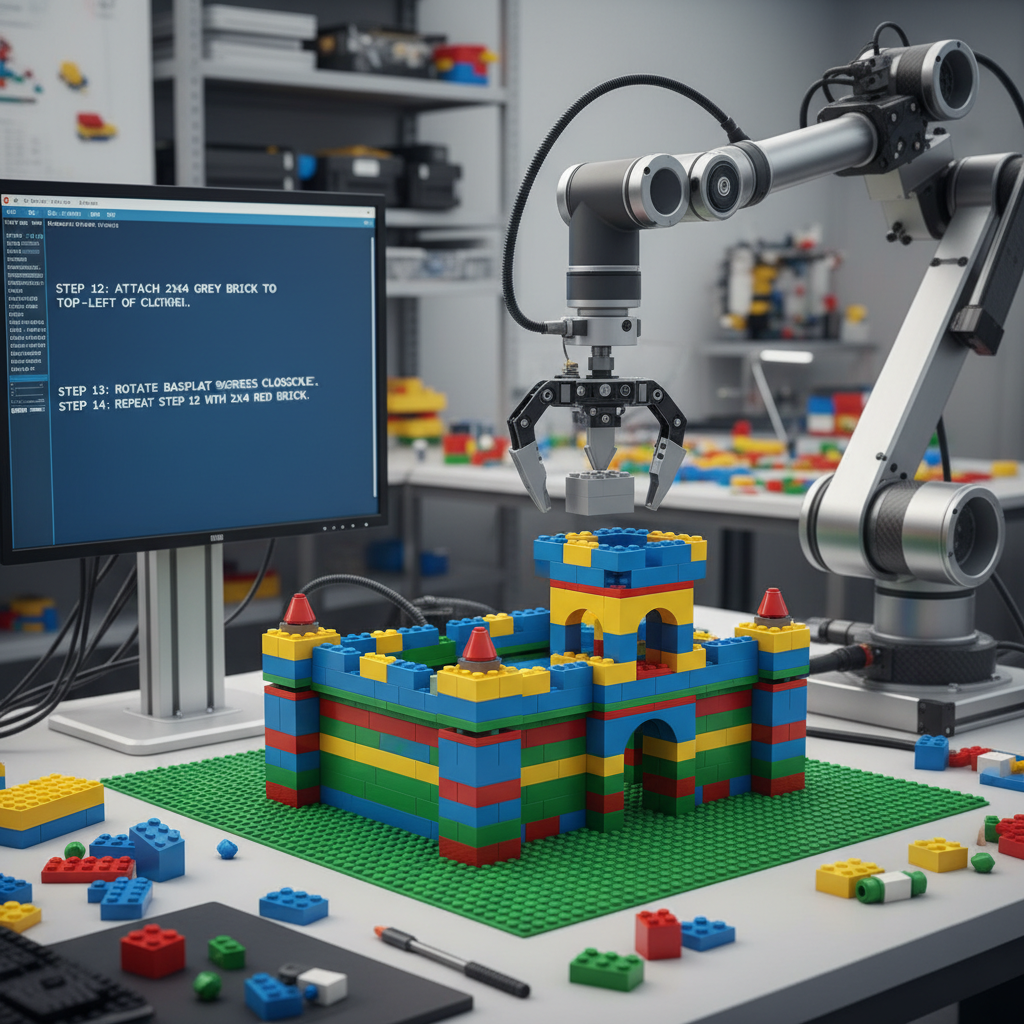
The researchers performed extensive experimental testing with both robots and humans to demonstrate the practical usability of designs produced by LegoGPT. The creation of AI-generated models followed determined brick sequences using a sophisticated dual-robot arm system with force sensors for precise manipulation. Human testers built some AI-designed Lego creations during the evaluation process to provide concrete proof that LegoGPT produces stable and buildable Lego structures that faithfully follow their text prompts. The experiments confirmed how the system transforms written descriptions into physical Lego models that match the desired designs and maintain sufficient structural strength for real-world assembly. The fact that both robots and humans could effectively build the designs illustrates the practicality and durability of the AI-generated instructions.
Among existing AI systems that create 3D models, LegoGPT stands apart because its chief mission is to ensure structural integrity without deviation. Throughout testing, the team found their method produced a much larger percentage of stable structures than other approaches, which typically emphasized visual aesthetics instead of physical stability. The LegoGPT system functions in a fixed space measuring 20×20×20 units and makes use of only eight basic types of Lego bricks.
The researchers recognize the current system’s limitations and have detailed future development strategies that will enhance the system to manage bigger and more intricate designs using a greater assortment of brick types, like slopes and tiles. The team will probably need to refine both the AI model and the physics simulation to manage the greater complexity in their expanded system. LegoGPT’s achievement in merging language understanding with physics simulation represents a major advancement for AI technology in physical construction design.
The Broader Implications of LegoGPT
LegoGPT’s capabilities have implications that reach beyond its current function of creating Lego models. LegoGPT can convert abstract text instructions into practical structures with strong stability and buildability, which indicates potential uses in engineering and architectural domains. Future designers will be able to articulate structural components and robotic assemblies through natural language, which enables AI systems to produce precise, buildable instructions, including stability assessments. The application of this technology has the potential to improve design efficiency while reducing mistakes and making the development of sophisticated physical products accessible to a wider audience. The progress of AI technology, together with platforms like LegoGPT, will lead to more streamlined design processes and efficient manufacturing across different sectors while merging the digital design phase with actual physical production.
LegoGPT marks a major advancement in AI-driven design through its distinctive ability to create structures that are both visually attractive and physically viable based on text inputs. The emphasis on core principles of stability and buildability creates a new standard for AI in physical construction while suggesting a future where AI becomes essential in materializing digital designs.


