- calendar_today August 12, 2025
.
Washington and New Delhi developed what was frequently lauded as the most successful post–Cold War strategic partnership over more than two decades. But now, that relationship is on one of its most challenging courses as years of trust built between the two countries face a growing threat from tariffs, oil politics, and new geopolitical realities.
“The trust is gone,” Evan Feigenbaum, the South Asia director at the Carnegie Endowment for International Peace, told FP. “We’re in a situation in the U.S.-India relationship where the premises and assumptions of the last 25 years, which is to say all of the Obama years and the president’s first term, which everybody worked very hard to build, have just come completely unraveled.”
President Donald Trump has placed a tariff on all imports from India that began at 25 percent and will double to 50 percent on August 27, after New Delhi did not stop purchases of Russian crude in the wake of the war in Ukraine. But rather than persuade India to change course, the move has only pushed Delhi closer to Moscow and even Beijing.
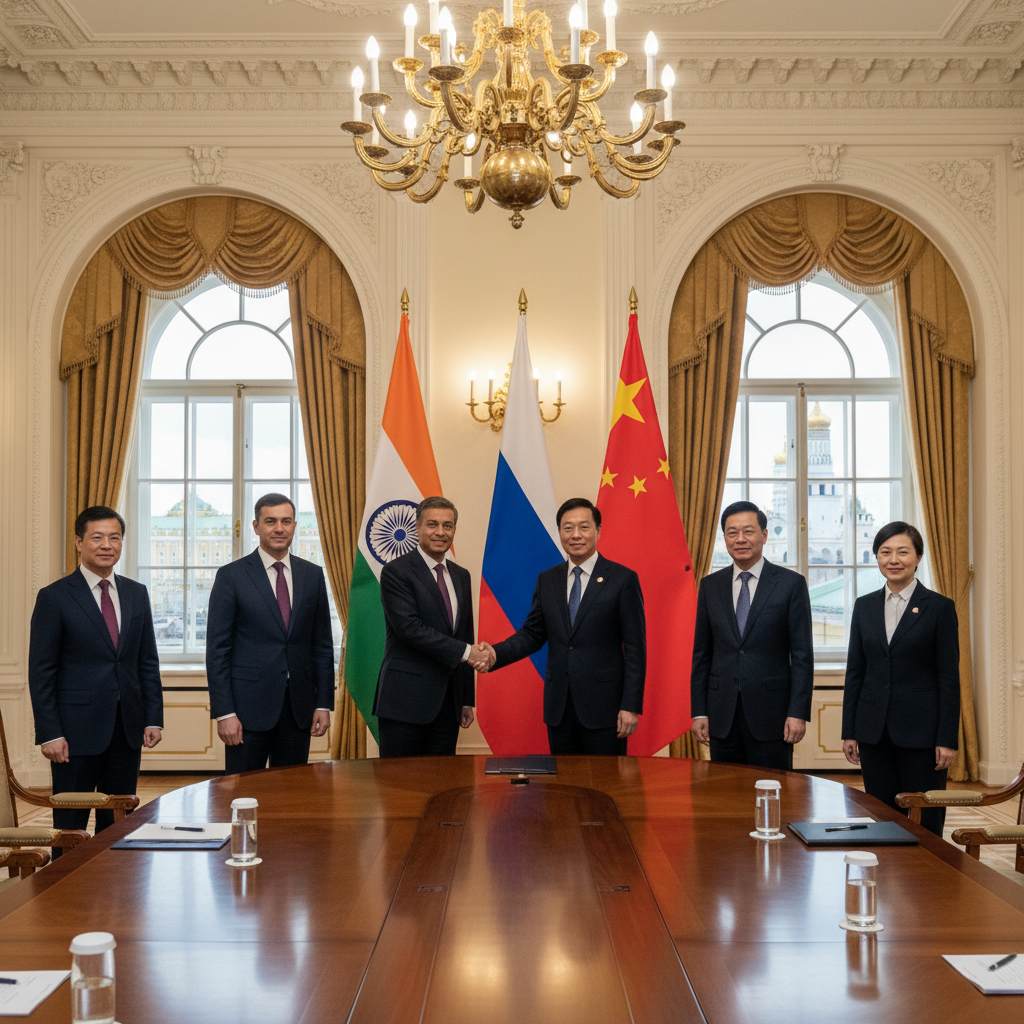
India’s national security adviser, foreign minister Subrahmanyam Jaishankar, and Chinese Foreign Minister Wang Yi all met in Moscow last week. And Modi is set to travel to China later this year for the first time in over seven years and will be welcomed in Moscow by Putin before the end of the year. Moscow, in particular, is more than just posturing, analysts say.
Indian domestic public opinion is also hardening against what is being perceived as U.S. attempts at interference in India’s sovereign decision-making. “They’re signaling very clearly that they view that as interference in India’s foreign policy, and they are not going to put up with it,” Feigenbaum added.
After a pause at the beginning of the war, Indian state-run refiners returned to importing Russian oil as discounts from Moscow of 6 to 7 percent became available. In May, Russia supplied the South Asian nation with 35 percent of its crude, up from less than 0.2 percent before the Ukraine war. Moscow, for its part, is also doubling down. Russian Deputy Prime Minister Denis Manturov said Moscow would continue to ship crude, oil products, thermal and coking coal, and see “potential for the export of Russian LNG.”
Trump Tariffs and Modi Domestic Politics
Michael Kugelman, a South Asia analyst at the Washington-based Wilson Center, argued that Trump’s tariffs weren’t the only reason for India’s strategic drift. “We’ve seen indications for almost a year of India wanting to ease tensions with China and strengthen relations, mainly for economic reasons. But the Trump administration’s policies have made India want to move even more quickly,” he said.
Some of the steps India has taken could be diplomatic theater, analysts say, but some seem more structural. “India is going to double down on some aspects of its economic and defense relationship with Russia — and those parts are not performative,” Feigenbaum said.
India had been moving away from a “lopsided” arms relationship with Russia before the Ukraine war and had brought in U.S., French, and Israeli systems. But as Russia attacked Ukraine, Delhi turned to Moscow for its energy trade. Kugelman called it “a triumph for India’s worldview that the U.S. can’t be trusted, whereas Russia can — because Russia is always going to be there for India no matter what.”
For Modi’s nationalist government, the diplomatic pivot is also good politics back home. By striking a tough stance, Modi is signaling that he will protect the livelihoods of farmers, small businesses, and young workers in India. That message has great resonance domestically. “India had already given to the U.S. on things like tariff concessions, on repatriating Indian workers, on other things,” Kugelman said. “Because of those concessions, India needs to be careful about signaling further willingness to bend. This is one reason there was no trade deal — Modi put his foot down.”
In the United States, impatience is growing. Peter Navarro, Trump’s former top White House trade adviser, wrote in the Financial Times that India’s purchases of Russian oil were “opportunistic” and “deeply corrosive.” In an op-ed, Navarro argued that tariffs are a necessary way of punishing India “where it hurts — its access to U.S. markets — even as it seeks to cut off the financial lifeline it has extended to Russia’s war effort.”
Points of Friction, Points of Compromise
The souring comes at odds with other key junctures in the relationship. In 2008, then-president George W. Bush signed a civil nuclear deal with India that would allow New Delhi access to American fuel and technology despite India’s status as a non-signatory to the Non-Proliferation Treaty. But in the years after, both countries were able to compartmentalize many points of friction — including those over Pakistan and India’s trade with Iran and Russia — so that disagreements in one area didn’t impact the broader partnership.
Much has changed in 15 years. Washington has long seen India as a key democratic counterweight to China in the Indo-Pacific region championed by Obama, Trump, and now Biden. But if the frictions continue to bleed into areas of defense and intelligence cooperation, that foundation will also come under pressure.