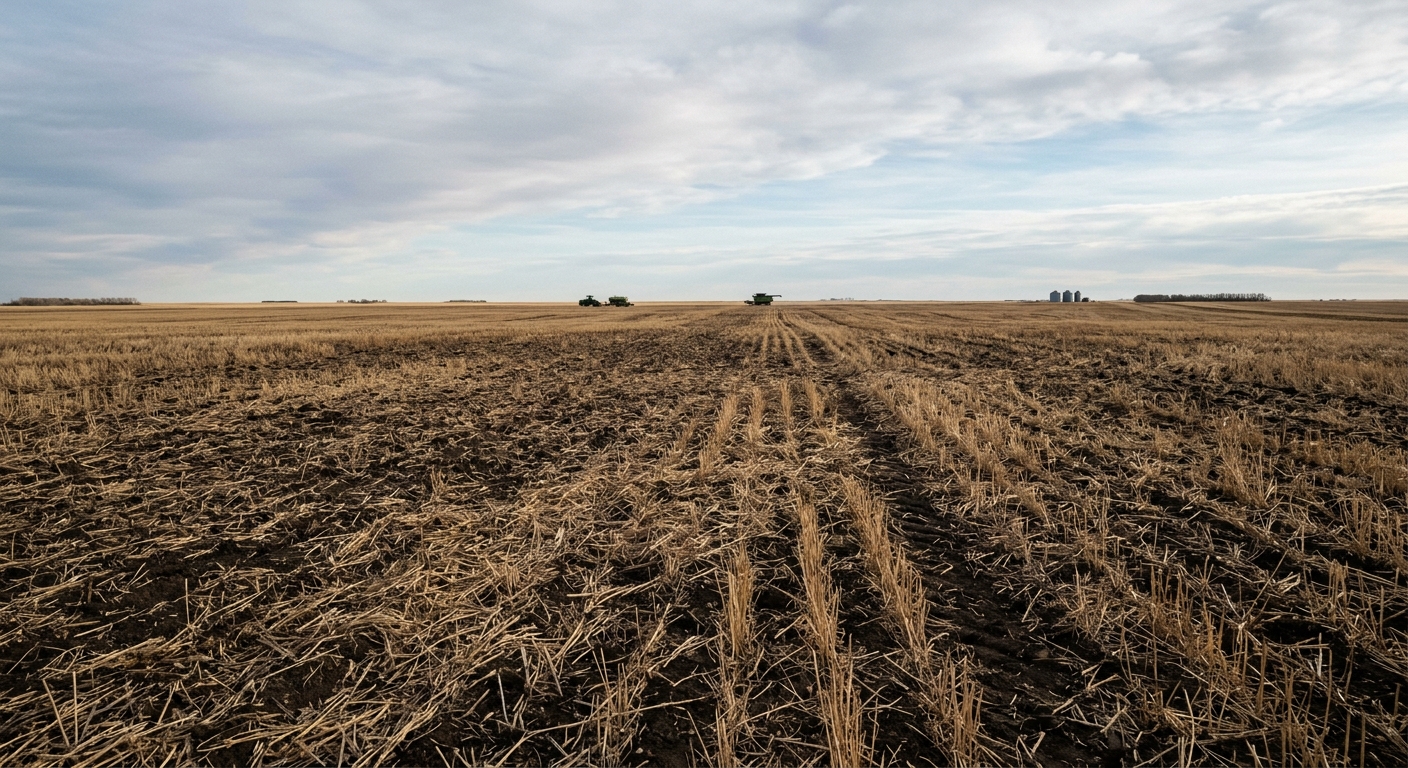
AI-generated illustration; not a photograph of the reported event.
- calendar_today November 10, 2026
Zero-Till Farming Drives Soil Organic Matter Increase in Saskatchewan
A new study has found that the shift to zero-till farming in Saskatchewan has improved soil health significantly, with soil organic matter levels rising by 41 percent over the last three decades. Producers and experts are acknowledging these gains while also exploring further measures to advance soil stewardship and farm productivity.
Adoption of Zero-Tillage Across Saskatchewan Farms
The transition to minimal and zero-tillage agriculture began in Western Canada in the late 20th century. Zero-till farming, which leaves soil largely undisturbed and covered with crop residue, is now widespread; as of 2021, the Canadian Agri-Food Policy Institute (CAPI) estimates 78 percent of farms in Saskatchewan follow zero-till practices.
Shawn Catherwood, a fifth-generation producer near Ceylon, Saskatchewan, practices zero-till farming on his diversified crop operation. “No-till has been that foundational practice that allows us to quite literally protect the skin of the Earth a little bit,” Catherwood said, emphasizing the importance of maintaining ground cover and protecting the soil microbiome.
Key Findings: Soil Organic Matter and Environmental Benefits
The recent research, co-authored by Stuart Smyth, a professor in the department of agricultural and resource economics at the University of Saskatchewan, collected data from Saskatchewan producers spanning several decades. Smyth reports, “At a provincial level, soil organic matter levels increased by 41 percent across the province.”
Besides building soil organic matter, zero-till practices have reduced wind and soil erosion and improved water retention—benefits that are especially valuable during drought conditions. The study also notes that by reducing runoff, zero-till helps keep herbicides, such as glyphosate, on the fields and out of nearby watersheds, limiting the spread of agricultural chemicals into the environment.
Producers See Room for Progress in Soil Health
While Saskatchewan farmers largely welcome the positive impacts of zero-till, some believe further practices could build on these gains. Bill Huber, president of the Saskatchewan Association of Rural Municipalities (SARM), credits producers for adapting to zero-till, noting, “Thank goodness we are looking after our soil, looking after our productivity concerns, and trying to manage things as efficiently as we can.”
Huber suggests integrating livestock and expanding grass cover, particularly on less productive land, as effective steps to further enhance soil health without heavy fertilizer input or intensive management.
Regenerative Agriculture and Innovations on the Horizon
Shawn Catherwood is embracing regenerative agriculture alongside zero-till, focusing on limiting soil disturbance, armouring the soil, diversifying crops (such as planting cover crops like triticale), and planning to reintroduce livestock—specifically bison—into his operation this winter. While acknowledging the term “regenerative agriculture” can be contentious due to changing definitions and concerns over “greenwashing,” Catherwood believes continuous innovation and open-mindedness will be key in pushing soil health improvements even further.
“One tool or one practice change isn't going to solve all of our issues,” Catherwood said, emphasizing the need for a holistic approach and respect for natural processes. “We have to do everything we can to essentially work within the laws of nature, because if we try to fight nature all the time we're not going to win that battle.”
Looking Ahead for Saskatchewan’s Soil
As Saskatchewan producers reflect on decades of progress due to zero-till farming, many are evaluating additional strategies—like cover crops and livestock integration—to build upon this foundation. Researchers and producers alike agree that maintaining soil health and farm productivity will require continuous adaptation and a commitment to sustainable land management.
Source: cbc.ca.