- calendar_today August 15, 2025
30 Years of Species: Sci-Fi’s Sexiest Killer Alien
A few weeks ago, the Hollywood community was shaken when news arrived of actor Michael Madsen’s death. He was a tough-talking, instantly recognizable fixture in the films of Quentin Tarantino, appearing in both Reservoir Dogs and Kill Bill, as well as a host of fan-favorite independent films and Hollywood blockbusters, including the celebrated Donnie Brasco. Few obituaries for the actor noted that he once took on one of the more unusual roles of his career as a black ops mercenary on the hunt for a half-alien, half-human hybrid in the 1995 sci-fi thriller Species. As the film turns 30 years old this year, there’s a reason why it bears revisiting.
In an era where monster flicks were a dime a dozen and UFO paranoia ran rampant, Species was something of a fever dream, a strange but ambitious mix of hard sci-fi and erotic horror that tried to balance the visuals of a deep-space thriller with some sharper sociological concepts. Directed by Roger Donaldson (No Way Out, The Bounty), Species imagined a future where two transmissions were received from space at the same time: one included information on a revolutionary fuel source while the other provided precise instructions for splicing alien DNA with human DNA. The government, naturally, acted on the information, constructing a single hybrid in the shadowy walls of a secret lab.
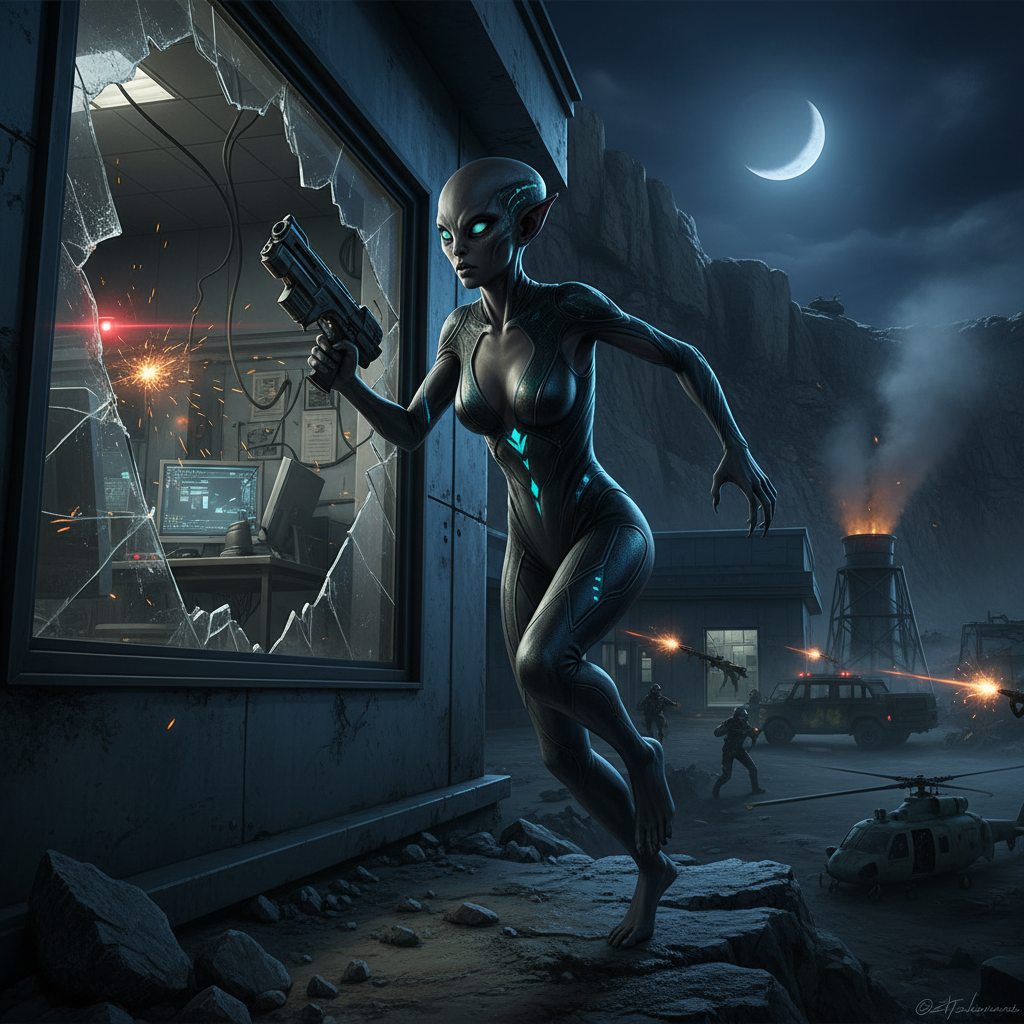
Played by Michelle Williams in her early years and Natasha Henstridge in her adult form, the product of that splicing was a creature the researchers named Sil. For its architects, the hybrid was designed to be calm and controllable, docile and a slave to human instruction. Instead, Sil proved to be something else entirely.
Sil learned rapidly, growing up in the body of a 12-year-old girl in only three months. But something was wrong. She had violent nightmares and strange signs of a more predatory, violent instinct. When her creator, the manipulative Dr. Xavier Fitch (Ben Kingsley), attempts to end the project by releasing cyanide into her containment cell, Sil manages to escape the facility, setting off the central plot of Species.
To find her, Fitch (Ben Kingsley) hires a team of specialists to hunt her down: Madsen’s Preston Lennox, a hard-bitten mercenary; molecular biologist Dr. Laura Baker (Marg Helgenberger); Dr. Stephen Arden (Alfred Molina), an anthropologist; and Dan Smithson (Forest Whitaker), a hunky, brooding empath who can somehow read Sil’s emotions. Traveling across the country to track down the missing hybrid, the team eventually lands in Los Angeles, the place where Sil, now grown up and sexually mature, begins her hunt to mate and reproduce, using her natural intelligence, adaptability, and primal instincts to seduce and kill her way to a human mate.
A Sensual, Murderous Monster
Species, then, was something of a sex-charged, serial-killer flick, as the government task force attempts to hunt down a killer before she can procreate and populate the world with copies of herself. The most interesting part of that concept was the design of the creature itself, done by surrealist artist H.R. Giger, the architect of the infamous xenomorph from Ridley Scott’s Alien. Giger was tasked with imagining a monster that was “designed to be a different kind of alien than the Alien. That was the whole point of the job.” In a 1996 interview, he described Sil as “a sensual woman who is extremely murderous.”
Sil, whom Giger based on the likes of May West and Jane Birkin, was sleek, powerful, and deadly. In her final form, Giger described Sil as “a glass body but with carbon inside of her.” In his initial designs, Giger wanted to see several stages of Sil’s alien evolution throughout the film, but was limited by time and budget constraints and ultimately created one stage of transformation cocoon and one design for Sil’s final, maternal alien form.
Giger was unhappy with the finished product: He saw Species as a pale, expensive, inferior retread of his Alien work, so similar in concept and design that he refused to have his name associated with it. Most notably, he had strong opinions about the famous vaginal birth scene, in which Sil expels her twin from her womb, and which he saw as a cheap, obvious take on the “chestburster” scene in Alien. Giger went so far as to intervene during the production process and order that Sil be killed with a bullet to the head, rather than engulfed in flames by a flame-thrower, since the former was reminiscent of Alien 3 and Terminator 2, not Alien.
Species, in the end, was not a darling of critics. The characters were mostly unlikable, the dialogue mostly wooden, and the themes mostly ignored or glossed over. Kingsley’s Fitch is amoral, untrustworthy, and kind of a jerk; Whitaker’s empath largely has nothing to do but commentate, look hot, and sense Sil’s mood from across the room. There are concepts—bioethics, first contact, maternally-driven science, and instinct—that Species flirts with but never fully explores. It’s an empty shell of a concept: a big-budget Alien retread shot on soundstages in and around Hollywood.
But that doesn’t mean that it’s not a hell of a ride. Species was, at its best, a horny bad dream, half soft sci-fi and half ultraviolent ’90s monster flick. Feldman, who wrote the screenplay for the film, took his inspiration for the concept from an old article by Arthur C. Clarke on the improbability of faster-than-light travel. In his estimation, Clarke suggested, aliens might never make it to Earth and Earthlings may never make it to the stars, simply due to the challenges of building a sustainable rocket. What if, Feldman wondered, an extraterrestrial species with the right amount of motivation managed to get in contact with Earth, but with blueprints for an organic, living, sentient life form rather than a flying machine?
What if, in short, an alien species tried to make a crack at Earth by using the planet’s DNA?
Species was, then, as much a creature feature as it was a cautionary tale: a vivid, memorable warning of what the future might look like in an era where people feared less sex and more government surveillance. For all its ambition, it was never likely to compete with Alien or Terminator 2 on a popular level; instead, Species carved out its own, special niche, making its case as a cult classic and tough-to-watch relic from a long-gone age of ’90s schlock, with a special thanks to H.R. Giger and the unforgettable Michelle Williams. Three decades later, Species is a time capsule of what Hollywood sci-fi looked like in an age when style often trumped substance—and a fascinating reminder of one of the stranger, more complex roles in Madsen’s career.